4-Week Home Workout Plan: Minimal Gear + Daily Stretches
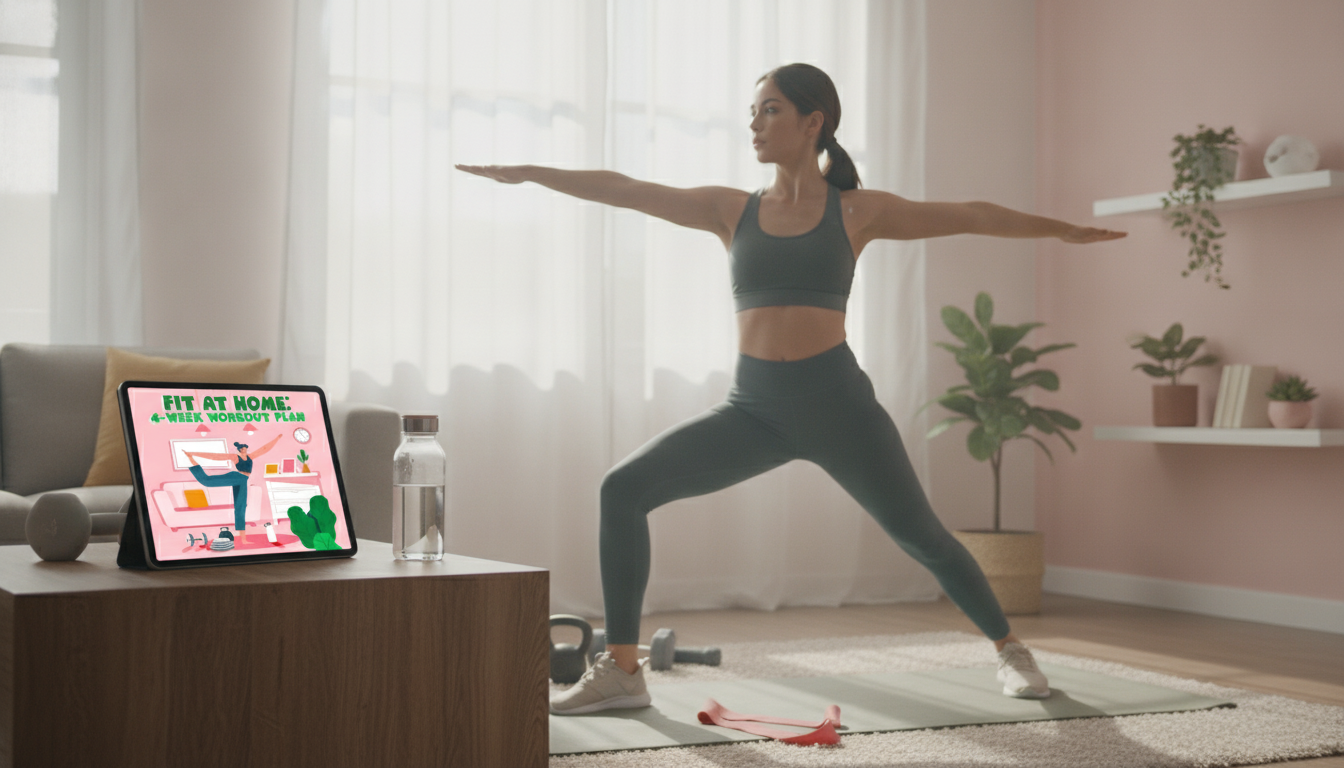
Fit at Home: 4-Week Minimal-Equipment Plan With Daily Workouts and Stretches
A structured four-week routine can build strength, improve conditioning, and support mobility without a full gym. This plan uses simple movements, short sessions, and repeatable templates so it’s easy to follow at home, adjust to fitness level, and stay consistent across busy weeks. Expect a blend of strength days, low-impact conditioning, and daily stretches designed to reduce stiffness and help recovery.
What This 4-Week Plan Looks Like
The rhythm is intentionally predictable: three strength-focused days, one conditioning day, two mobility/recovery days, and one full rest day (all adjustable). Most sessions take 20–40 minutes including warm-up and cool-down, which makes it easier to start—and easier to repeat.
Progression is simple: add a couple reps, add a set, shorten rest a bit, or choose a slightly harder variation while keeping technique strict. Daily stretching (5–10 minutes) is built in to keep hips, hamstrings, shoulders, and upper back moving well.
Weekly Schedule Snapshot (Repeat for 4 Weeks With Gradual Progression)
| Day | Focus | Main Work | Stretch Emphasis |
|---|---|---|---|
| Day 1 | Full-body strength A | Squat pattern + push + core | Hip flexors, chest |
| Day 2 | Mobility + easy cardio | Walk/cycle + joint flow | Thoracic spine, calves |
| Day 3 | Full-body strength B | Hinge pattern + pull + glutes | Hamstrings, lats |
| Day 4 | Conditioning | Intervals (low impact options) | Quads, ankles |
| Day 5 | Full-body strength C | Unilateral legs + shoulders + core | Glutes, shoulders |
| Day 6 | Recovery + stretch | Light mobility circuit | Full-body reset |
| Day 7 | Rest | Optional easy walk | Gentle stretch if desired |
Minimal Equipment (and No-Equipment Alternatives)
You can run this plan with almost nothing, but a few basics make progress easier: an exercise mat, a light-to-moderate set of dumbbells or a kettlebell, and a long loop resistance band.
- Household swaps: use a backpack loaded with books for squats, hinges, and carries; use a towel for isometric “rows” (pulling against it); use a sturdy chair/sofa edge for incline push-ups and step-ups.
- Small-space friendly: most moves are stationary—squats, hinges, push-ups, rows, planks—plus optional low-impact cardio.
- Optional add-ons: a mini-band for glute work, or a door anchor for bands (only if safe and secure).
Warm-Up Template (5–7 Minutes)
Think of the warm-up as a quick “system check”: get your breathing down, open key joints, and switch on the muscles you’re about to use.
- Breathing reset (30–60 seconds): slow nasal breaths to reduce tension before training.
- Mobility (2–3 minutes): cat-cow, hip circles, arm circles, and ankle rocks.
- Activation (2–3 minutes): glute bridges, dead bugs, and scapular push-ups.
- Ramp-up set: do one easy round of the first two exercises before your work sets.
Strength Day Templates (Rotate A, B, and C)
These three templates cover the core patterns—squat, hinge, push, pull, carry, and core—without making you juggle a long exercise list. Rest 45–90 seconds between sets and keep 1–2 reps in reserve so form stays clean.
Strength A (Squat + Push)
- Bodyweight or goblet squat: 3 x 8–12
- Incline or knee push-ups: 3 x 6–12
- Plank: 3 x 20–45 seconds
- Optional finisher: brisk step-ups for 5 minutes
Strength B (Hinge + Pull)
- Hip hinge (Romanian deadlift with dumbbells/backpack): 3 x 8–12
- Band row or towel row isometric: 3 x 10–15
- Glute bridge: 3 x 10–15
- Optional: side plank 2–3 sets
Strength C (Unilateral + Shoulders)
- Split squats: 3 x 6–10 per side
- Overhead press (band/dumbbells): 3 x 8–12
- Farmer carry (weights/backpack): 3 x 30–60 seconds or hollow hold: 3 x 15–30 seconds
Form checkpoints: use a controlled lowering phase, keep full-foot contact on leg work, keep ribs down during pressing, and maintain a neutral spine during hinges.
Conditioning Day Options (Low Impact Friendly)
Daily Stretch Routine (5–10 Minutes)
For general mobility and flexibility guidance, the NIH overview on stretching is a helpful reference: NIH MedlinePlus — Stretching.
How to Progress Across the 4 Weeks
For a big-picture benchmark on weekly activity targets, see: CDC — Physical Activity Guidelines for Adults. For resistance training best practices, the ACSM resource library is a solid starting point: American College of Sports Medicine (ACSM) — Resistance Training Recommendations.
Staying Consistent: Timing, Recovery, and Tracking
Downloadable Plan Format and What’s Included
- Fit at Home: 4-Week Workout Plan (PDF eBook) — a day-by-day structure with repeatable templates for strength, conditioning, and stretching.
- Minimal-equipment guidance with clear progressions and substitutions for tight spaces and busy schedules.
- A simple completion checklist so you can start quickly and stay consistent.
For an easy at-home setup, a phone timer can help keep rest periods honest during strength sets and intervals. If you want a mount that keeps your screen visible for timing, playlists, or interval prompts in the car or at home, consider: Magnetic 15W Wireless Car Charger & Phone Mount for iPhone 16–13.
FAQ
How many days per week should the workouts be done?
A solid default is 4–6 active days per week: three strength days, one conditioning day, and one to two mobility/recovery days. To scale down, do the three strength days plus daily stretching; to scale up, add a second easy cardio/mobility day if recovery feels good.
Is this plan suitable for beginners with no equipment?
Yes. Start with incline push-ups, bodyweight squats, and slow hip hinges, and use household substitutions like a backpack for resistance and a towel for isometric pulls. Progress gradually by adding reps first, then resistance or harder variations once form stays consistent.
How long should each daily stretch session take?
Most people can finish in 5–10 minutes by choosing 4–6 stretches and holding each for 20–45 seconds for 1–2 rounds. Doing it after workouts or in the evening tends to feel best for reducing stiffness.










Leave a comment